
Plagiarism & AI Removal - by Turnitin & Humans
Structured AI content and plagiarism removal to ensure academic originality and research integrity
In Paper Helper every thesis, dissertation, research paper, and journal manuscript undergoes structured plagiarism checking and AI content detection to ensure academic originality and university compliance.
Using Turnitin plagiarism reports and multi-layer AI screening protocols, research documents are evaluated against strict similarity thresholds and zero AI tolerance standards before submission.
This process helps PhD scholars, MBA researchers, and journal authors maintain plagiarism-free and AI-compliant academic work aligned with institutional guidelines.
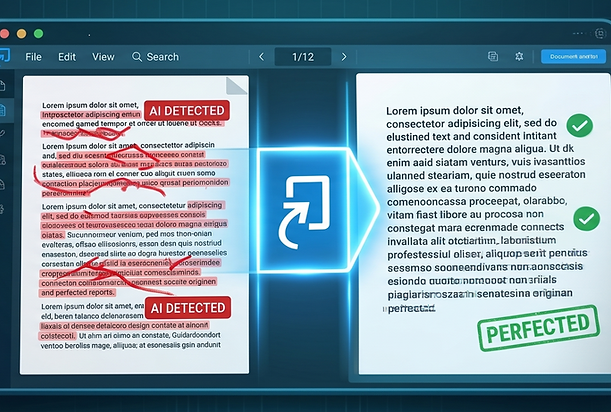
Professional AI Content and Plagiarism Removal Services Powered by Humans :)

Plagiarism Removal Services
High similarity scores may result from improper paraphrasing, structural overlap, or citation formatting issues. Here at Paper Helper Structured academic rewriting and citation correction are applied to reduce similarity while preserving meaning and research intent.
Academic paraphrasing and content restructuring
Citation correction and referencing alignment
Removal of improper textual overlap
Structural refinement of literature sections
Re-screening through Turnitin before final delivery
AI Checker and Removal Service
AI-detection tools may flag content due to repetitive structure, generic phrasing, or algorithmic patterns. At paper Helper manual academic refinement ensures the writing reflects scholarly tone and human-authored depth.
Manual rewriting and sentence restructuring
Enhancement of analytical depth and academic voice
Elimination of AI-patterned phrasing
AI re-screening prior to submission using Turnitin
Why Academic Originality Matters in Thesis and Research Submission?

Strict Plagiarism Screening by Universities
Most universities require Turnitin plagiarism reports and enforce low similarity thresholds for thesis and dissertation approval.

Growing Use of AI Content Detection Tools
Institutions increasingly apply AI-detection systems to identify non-original or AI-generated academic writing.

Originality Directly Impacts Approval & Publication
Plagiarism-free and AI-compliant research strengthens supervisor trust, viva performance, and journal acceptance outcomes.
100% Humanized & Plagiarism-Free Content Guaranteed; The Paper Helper Way!
Plagiarism Control Standards - Powered with Turnitin (<8%)
To ensure plagiarism-free thesis and dissertation submission, strict internal originality benchmarks are applied in Paper Helper:
Internal plagiarism threshold maintained below 8% similarity using Turnitin
Proper academic citation and referencing in APA, MLA, Harvard, or required formats
Bibliography, references, and properly cited quotations excluded from similarity calculation
Structured academic paraphrasing where necessary to maintain originality
Final Turnitin plagiarism screening conducted before document delivery and report provided to client.
These measures help ensure compliance with university plagiarism policies and journal submission requirements.
_svg.png)

AI Content Compliance Policy - Powered with Turnitin (0%)
Academic institutions increasingly use AI content detection tools to evaluate research submissions. To maintain academic integrity standards in Paper Helper:
Zero tolerance for detectable AI-generated academic content
Manual academic structuring and human-led writing processes
AI screening conducted prior to final delivery using Turnitin
Content prepared to align with university originality and integrity policies
Strict AI compliance ensures research authenticity, supervisor confidence, and institutional approval readiness.
Endorsed by Scholars. Proven in Review.
Case Study : Resolving High Plagiarism & AI Detection Risk in a Manually Written Thesis
Background : A PhD scholar in Management submitted a manually written thesis draft for plagiarism and AI screening before final university submission. Although the document was self-written without using AI tools, the Turnitin similarity report showed 18% similarity, and AI detection tools indicated moderate AI-risk probability.
Issue Identified :
The similarity percentage was elevated around 45% due to:
-
Overlapping theoretical definitions from standard textbooks
-
Repeated use of common academic phrasing
-
Improperly formatted citations
-
Structural similarity in the literature review
The AI detection flagged 67% which was triggered because:
-
Highly structured academic sentence patterns resembled AI-generated writing
-
Repetitive formal phrasing
-
Limited variation in linguistic flow
Despite being manually written, algorithmic screening tools flagged technical patterns.
Our Intervention :
-
Reworked overlapping theoretical explanations with deeper analytical interpretation
-
Improved citation formatting and quotation integration
-
Rephrased standard academic expressions with context-specific writing
-
Enhanced critical analysis to reduce generic sentence structures
-
Conducted re-screening through Turnitin and AI detection tools
Outcome : Similarity percentage was reduced to below 8% (excluding references).
AI detection risk dropped to negligible levels.
The thesis was submitted successfully without further originality-related revisions.

"Even though my thesis was completely written manually, the initial plagiarism and AI detection reports showed higher-than-expected similarity and AI-risk indicators. Paper Helper carefully reviewed the document, improved citation formatting, restructured overlapping sections, and refined the academic language. The final similarity score dropped below the university threshold, and the AI detection issue was resolved. I submitted my thesis with full confidence."
Rohan Mehta; PhD Scholar, Business Management, Delhi India
Frequently asked questions
- 01
- 02
- 03
- 04
- 05
- 06
- 07
- 08
- 09
- 10
.png)